
Reggio Emilia Philosophy: What It Means for Your Preschool Classroom
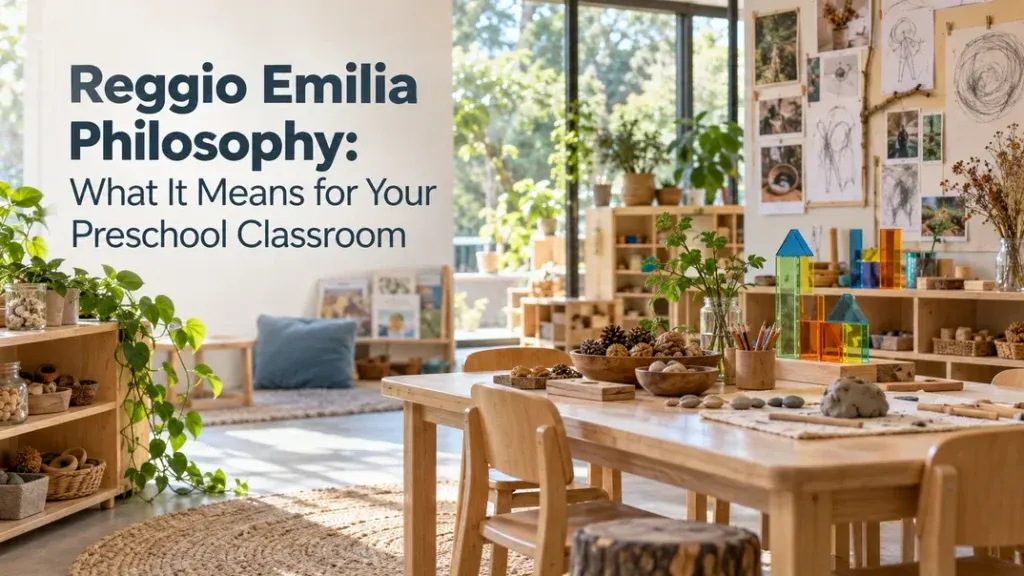
If you are planning a Reggio-inspired preschool, start with your view of the child—not with a color palette or a list of wooden toys. You should create a classroom where children can choose materials, work with others, revisit questions, and show ideas through drawing, movement, construction, words, and play. This guide explains the Reggio Emilia philosophy and turns its main principles into practical choices for your space, teaching practice, and purchasing plan.
What Is the Reggio Emilia Philosophy?
The Reggio Emilia philosophy is an approach to early childhood education that treats children as capable people with rights, ideas, and many ways to communicate. It developed through the municipal infant-toddler centers and preschools of Reggio Emilia, Italy. The approach connects children, educators, families, materials, and the environment in an ongoing process of inquiry.
You will often see the approach described through the “hundred languages of children,” the “environment as the third teacher,” emergent project work, and pedagogical documentation. These phrases are useful only when they change what you do each day: what you make available, what you observe, what you record, and how you decide what children should investigate next. The official Reggio Children overview describes the approach through relationships, atelier work, the environment as educator, documentation, and family participation.
What Are the Main Principles of Reggio Emilia?
When you plan a Reggio-inspired program, use the principles below as questions for your team rather than as a room-decorating checklist.
| Principle | What it means in practice |
|---|---|
| Children are capable and have rights | You treat children as active contributors. You listen to their ideas, give them meaningful choices, and expect their thinking to develop through experience. |
| The hundred languages | You offer many ways to think and communicate, including talk, drawing, clay, construction, music, movement, dramatic play, light, and found materials. |
| Learning happens through relationships | You plan for conversation, cooperation, disagreement, and shared problem-solving. A child’s learning is connected to peers, adults, family, and community. |
| The environment is an educator | You arrange space, light, materials, furniture, and displays so they invite investigation and make children’s work visible. |
| Learning is emergent and project-based | You follow meaningful questions as they develop. You still plan, but your next step responds to what children notice and do. |
| Documentation supports reflection | You record children’s words, actions, theories, and revisions so your team can interpret learning and plan a useful next invitation. |
| Families participate | You treat families as partners who bring knowledge, language, culture, and observations that can deepen classroom projects. |

How Should You Apply the Philosophy in Your Classroom?
Start by watching how children use your current room. Notice where they gather, which materials they combine, where conflicts begin, and which resources they keep asking an adult to reach. Then adjust the space around those observations. A Reggio-inspired classroom should support children’s current investigations while leaving enough room for the next question to change the arrangement.
Make materials visible and usable
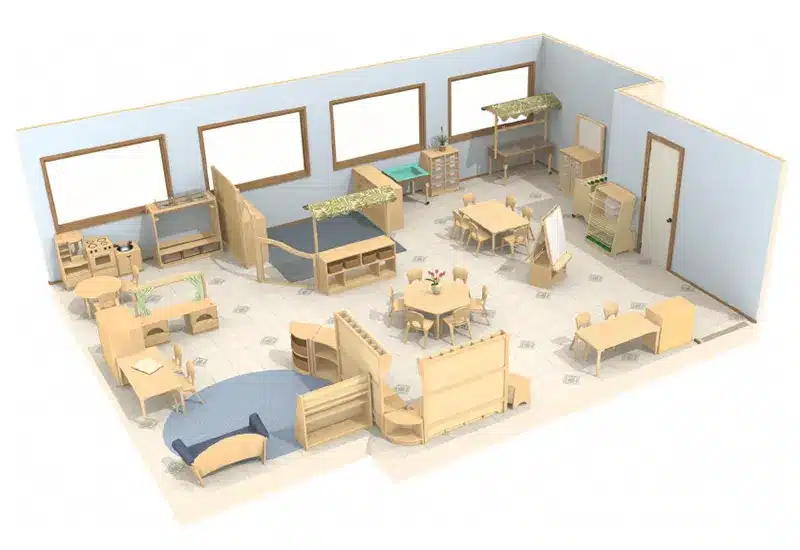
If children cannot see or reach a material, it is not part of their independent learning environment. Use low, open storage for resources that children can handle safely. Group materials by what children might investigate—building, mark-making, sorting, light, texture, sound, or storytelling—rather than placing every item in one crowded toy area.
Visibility does not mean putting everything out at once. You should offer a manageable selection, observe what children do with it, and rotate materials when interest changes. Too many loose parts create sorting and cleanup problems before they create deeper inquiry.
Design for both collaboration and retreat
Your room should let children work together without forcing every activity into a group. Place a shared table or floor workspace near open-ended materials, then provide a quieter area for reading, drawing, revisiting documentation, or taking a short break. Keep high-movement areas away from delicate work so children can concentrate and teachers can maintain clear sightlines.
Leave room for the environment to change
A fixed set of themed centers can make a classroom look organized while limiting children’s questions. Choose furniture that can move, combine, or serve more than one purpose. A worktable may support clay one week, mapping the school yard the next week, and collaborative construction after that. Your layout should make those changes easy instead of treating the room as finished once the furniture arrives.
For a deeper layout discussion, see this practical guide to planning a Reggio Emilia classroom. It covers access, flexible zones, natural light, displays, and movement through the room.
What Are the “Hundred Languages” of Children?
The “hundred languages” is a metaphor for the many ways children build and express knowledge. It does not mean that you need one activity for every possible medium. You should give children enough time and material choice to represent an idea in more than one way, then allow them to return to and revise that idea.
For example, children investigating insects might observe a live specimen outdoors, draw what they see, build a habitat with blocks, compare movement with clay models, dictate questions to a teacher, and use magnifiers or transparent materials to inspect details. The learning is in the connected investigation, not in producing identical insect crafts.

When you review materials, ask: Can children use this in more than one way? Does it invite comparison, transformation, or collaboration? Can you add it to a project already underway? Xiha Montessori organizes relevant options across Learn, Play, and Art categories, including building materials, light and shadow resources, science tools, clay, collage supplies, and sensory materials. You can review the Reggio Emilia learning materials collection by learning purpose instead of choosing items only because they look natural.
What Is the Teacher’s Role in a Reggio Classroom?
You are not expected to stand back and wait for children to teach themselves. In a Reggio-inspired classroom, you observe closely, listen for working theories, ask questions, introduce useful tools, and help children stay with an investigation. You also protect time, safety, inclusion, and the conditions needed for productive group work.
Emergent curriculum still needs professional planning. You can begin with a broad possibility—such as sound, shadows, bridges, or local plants—without deciding every outcome in advance. As children respond, you choose the next material, question, field observation, book, or expert that can extend their thinking. This is consistent with NAEYC’s discussion of emergent curriculum, which connects children’s interests with teacher observation and intentional follow-through.
How Does Pedagogical Documentation Work?
Pedagogical documentation is a working record of children’s learning process. It can include a short transcript, a photo of children testing an idea, a drawing that changed over time, a teacher observation, or a child’s question. The purpose is to make thinking visible so children, families, and educators can study it together.
- Observe: record a specific action, exchange, or question rather than a general judgment such as “good teamwork.”
- Interpret: ask what the children may be trying to understand and what evidence supports that interpretation.
- Re-present: place selected photos, words, sketches, and unfinished work where children can revisit them.
- Plan: decide what material, question, or change in the environment could support the next step.
Do not turn every wall into a display. Select documentation that helps children remember, compare, explain, or change an idea. Keep work at a child’s eye level when possible, protect privacy, and make sure teachers can update the display as the project develops. A documentation panel that never changes becomes decoration rather than a teaching tool.
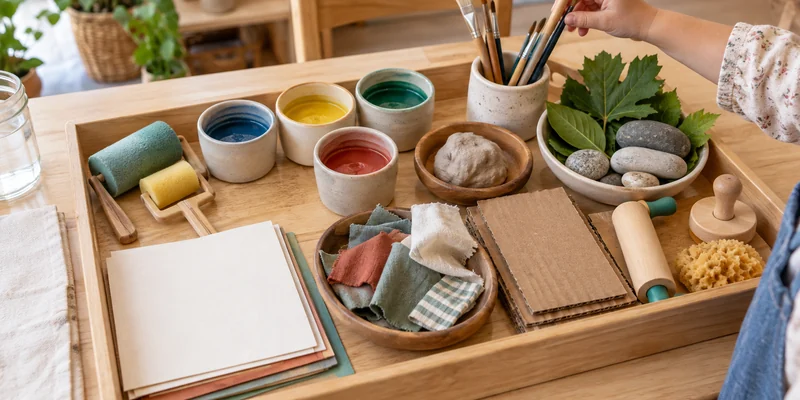
An atelier can support this process, but it is more than an art corner. It is a place where children can investigate materials, make theories visible, and work with an educator who understands creative processes. If you are setting up one, place it near water access when possible, use surfaces that tolerate paint and clay, provide drying or holding space for unfinished work, and plan how tools will be supervised.
For practical decisions about location, work surfaces, materials, and cleanup, use this guide to setting up a preschool art center.
How Should You Choose Furniture and Materials?
You should choose furniture after you define the activity it needs to support. A low shelf is useful when children can reach the materials, see the choices, and return each item to a clear place. A table is useful when its shape, height, surface, and position support the way children will work. A beautiful piece that blocks sightlines or cannot handle daily cleaning is a poor classroom purchase.
- Access: can the intended age group reach and carry the materials safely?
- Visibility: can children and teachers see what is available and what is happening?
- Flexibility: can you change the layout when a project moves from individual work to group work?
- Durability: can the surface handle frequent use, wiping, moisture, paint, glue, or clay?
- Supervision: can adults monitor tools, small parts, wet work, and movement without hovering over every child?
- Expansion: can you add modules or change the arrangement as the group’s interests develop?
A practical Xiha Montessori viewpoint is to judge a product by the learning behavior it supports, not by whether it matches a Reggio-inspired color scheme. Our Furniture, Learn, Play, Art, and Outdoor categories can be combined by age group, room function, and layout. You should confirm the current material, finish, dimensions, cleaning requirements, packaging, delivery conditions, and customization scope before approving a purchase.
You can compare classroom furniture by function through the Xiha Montessori preschool furniture collection. For projects that need open access and clear material visibility, review classroom storage solutions alongside the floor plan rather than choosing storage as a separate order.
If you are planning a Reggio-inspired room, send your floor plan, age range, and main activity goals to Xiha Montessori for practical layout and product direction.
Contact Our Team for More Information Get CatalogWhat Mistakes Should You Avoid?
- Copying the look without changing the practice: natural wood, plants, and neutral colors do not create a Reggio classroom by themselves.
- Buying before observing: you may fill the room with materials that do not answer children’s real questions or fit your daily routines.
- Offering too much: an overfilled shelf hides choices and makes independent cleanup unrealistic.
- Turning documentation into decoration: a display should help children revisit thinking, not simply show finished work.
- Confusing emergent work with no structure: children still need boundaries, supervision, routines, intentional questions, and a teacher who prepares the next step.
- Ignoring adult workflow: if teachers cannot clean, store unfinished work, or reach supplies quickly, the environment will not remain usable.
Frequently Asked Questions
Is Reggio Emilia a curriculum?
It is better understood as an educational philosophy and approach than as a fixed curriculum package. You can use curriculum goals and local requirements while planning projects from children’s observations, interests, relationships, and questions.
Do you need a separate atelier?
No. A dedicated studio can provide useful space and specialist support, but a small classroom atelier or mobile materials station can also support investigation. The quality of observation, material choice, and reflection matters more than having a room with a particular name.
How is Reggio Emilia different from Montessori?
Both approaches respect children’s agency and the role of a prepared environment. Montessori classrooms more often use a defined sequence of developmental materials and individual work choices. Reggio Emilia places more emphasis on collaborative inquiry, project work, expressive languages, and documentation that changes with children’s questions. If you combine ideas from both, be clear about which practices your teachers can sustain.
How can you start if your classroom is small?
Start with one current question and one well-organized materials area. Use a mobile cart, low shelf, or shared worktable to make the investigation visible, then document what children do before buying more. A focused setup usually gives you better information than a full-room redesign based on a generic theme.
How Can You Begin?
Choose one part of your classroom—a materials shelf, art area, documentation wall, or shared table—and ask what it currently communicates to children. Can they see meaningful choices? Can they work together? Can they return to an unfinished idea? The Reggio Emilia philosophy becomes useful when your answer leads to a specific change in observation, space, materials, or teacher planning.

Hey, I’m Roger, the founder of Xiha Montessori, a family-run business. We specialize in preschool furniture and educational solutions.
Over the past 20 years, we have helped clients in 55 countries and 2000+ preschools, daycares, and early childcare centers create safe and inspiring learning environments.
This article shares knowledge on making education more effective and enjoyable for children.
Wooden Preschool Furniture Care Guide For Busy Classrooms
Read More »
How to Childproof a Daycare Classroom: A Practical Safety Checklist
Read More »
Daycare Cribs Buying Guide: How to Choose Safe, Practical Sleep Furniture
Read More »
Object Permanence: What Babies Learn and How Montessori Activities Support It
Read More »
Effective Preschool Classroom Rules: How to Create a Safe and Orderly Learning Environment
Read More »
How to Start a Daycare: A Practical Planning Guide
Read More » Roger Cai
Education Specialists
Hey, I’m the author of this post.
Over the past 20 years, we have helped 55 countries and 2000+ Clients, like Preschools, Daycare, and Early Childcare Centres, to create safe and inspiring learning environments.
If you need a purchase or consultation, please contact us for a free product catalog and classroom layout design.