
How to Support Gifted Preschoolers in the Early Learning Environment
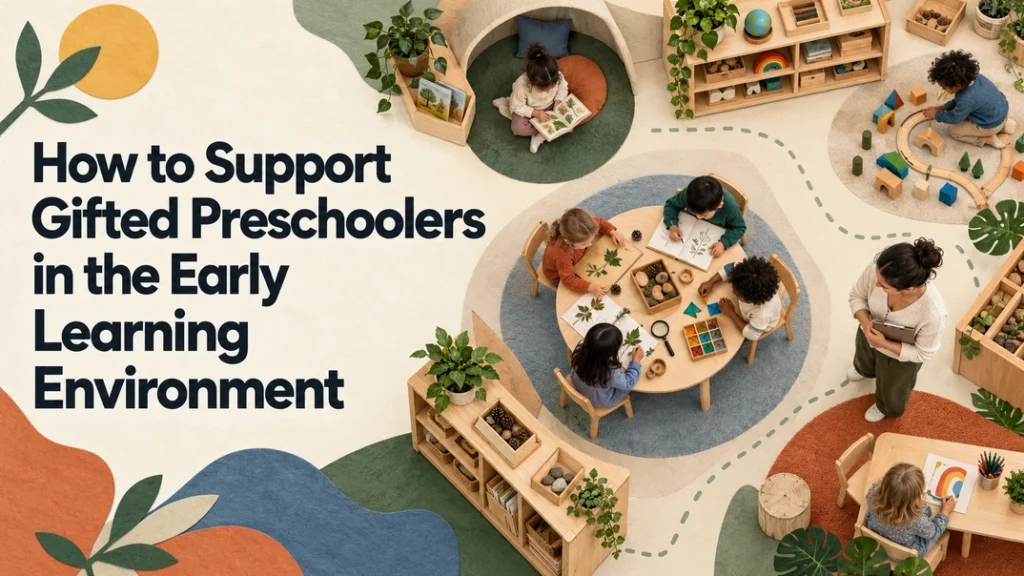
Gifted preschoolers need a classroom that responds to what they already understand and what they are ready to investigate next. A strong early learning environment combines careful observation, flexible pacing, open-ended materials, quiet concentration, peer interaction, and age-appropriate play. This guide shows preschool directors and educators how to build that system without turning one child’s advanced ability into a fixed label or a separate curriculum.
What Giftedness Can Look Like in Preschool
Gifted behavior can appear as advanced vocabulary, early reading or number understanding, unusual memory, intense curiosity, complex pretend play, original problem-solving, or long periods of concentration on a chosen topic. These are clues to investigate, not a checklist that confirms a label.
Young gifted learners are a varied group, and their development may be uneven. A child may reason far beyond age expectations while still developing age-typical fine-motor skills, self-regulation, or social confidence. This asynchronous pattern in children ages 3 through 8 calls for whole-child support, with each domain advanced only when the evidence supports it.
Advanced potential can also be missed when a child is learning a new language, has a disability, comes from a different cultural background, or has had fewer opportunities to show a skill. Giftedness develops over time, so multiple observations and measures give a fairer picture than one test, one milestone, or one impressive classroom moment.
Start With Observation, Not a Fixed Label
Teachers need evidence of how a child thinks, learns, and responds to challenge. Observe the child in construction, language, mathematics, art, dramatic play, outdoor exploration, and group routines. A child who reads early may need literacy extension, while the same child may need ordinary support in physical or social development.
A useful observation note records four things:
- The activity and the level the child completed without help.
- The strategy, questions, connections, or originality the child showed.
- How long the child remained engaged and what caused frustration or withdrawal.
- The next extension offered and how the child responded.
Compare these notes over time and discuss patterns with the family. Family input can reveal interests or abilities that do not appear at school, while classroom evidence shows how the child works among peers and within routines. If formal identification is needed, follow the program’s local policy and use qualified professionals. A preschool teacher’s observation is valuable evidence, but it is not a clinical or psychological diagnosis.
Build a Classroom That Can Stretch
Before buying “advanced” materials, map three conditions in the room: where a child can work without frequent interruption, where a small group can collaborate, and whether teachers can supervise both areas. The same child may need solitude for a complex design and peers for discussion later in the day.
Low, open shelving can support independent material choice when the shelf height suits the children using it. Shelves may also define learning zones, but every proposed position should be tested from normal teacher locations. A divider that improves concentration can also create a blind spot. Walk the layout when the room is empty, then review it again during a typical activity period.
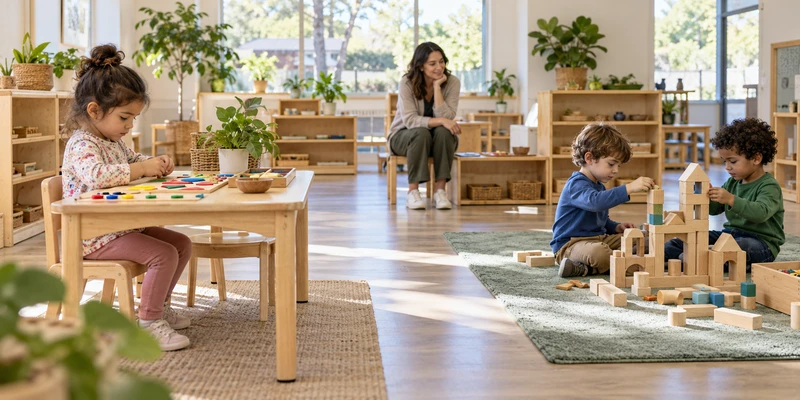
Use a mix of individual work surfaces, small-group tables, floor work areas, and a quiet nook that remains visible to staff. Clear pathways help children move materials safely and allow teachers to reach each zone quickly. Current gifted education standards call for opportunities for both solitude and social interaction, so a flexible room serves learning better than one permanent “gifted area.”
Choose Materials With a Clear Extension Path
A smaller, sequenced material collection usually works better than crowded shelves. Start with materials that the whole class can use, then plan extensions that change the depth, complexity, or number of possible solutions. This keeps the classroom inclusive and reduces the need to purchase a separate set for one child.
| Learning Area | Starting Experience | Useful Extension | Space and Storage Need |
|---|---|---|---|
| Blocks and construction | Build, balance, compare, and represent familiar places | Add design constraints, measurement, testing, or a drawing of the final structure | Open floor space, stable work surface, and sorted components that children can return independently |
| Math and manipulatives | Count, sort, sequence, match, and compare | Ask the child to find a new rule, prove a pattern, or show the same idea in another way | Sequenced trays with enough space to lay out multi-step work |
| Literacy | Browse books, retell stories, label pictures, and form words | Offer richer nonfiction, compare viewpoints, research an interest, or create a book | A visible book display plus a quiet place for reading, writing, and discussion |
| Science and nature | Observe, classify, and describe changes | Form a question, predict a result, record evidence, and revise an explanation | A stable table and organized storage for tools, specimens, and documentation |
| Art and making | Explore color, texture, form, and different media | Plan a multi-stage work, compare techniques, or solve a design problem | Accessible tools, protected work surfaces, drying space, and storage for unfinished projects |
When you compare furniture or storage, check the actual materials that must fit. Tray dimensions, shelf depth, table area, component size, and the child’s reach determine whether an activity can be selected, completed, and returned without unnecessary adult help. Ask suppliers for product-specific dimensions and cleaning guidance; avoid assuming that one shelf or table will suit every age group and material set.
Adjust Pace, Depth, and Complexity
First confirm what the child has already mastered. When a child completes an activity accurately and can explain the idea, repeated practice can be replaced with a meaningful extension. Effective differentiated instruction in preschool may change the pace, the question, the materials, the level of independence, or the way the child represents an answer.
For example, a child who quickly sorts shapes can invent a second sorting rule and explain it. An early reader can compare two characters’ decisions or use books to investigate a personal interest. A confident builder can work within a material limit, test several structures, and document why one design worked. Each extension creates new thinking without assigning a longer version of work the child already understands.
Teacher language matters. Questions such as “What pattern do you notice?”, “How could you test that idea?”, and “Can you show another solution?” reveal reasoning and keep the child in control of the investigation. Use open-ended questions for preschoolers selectively; constant questioning can interrupt deep concentration.
Keep Play, Movement, and Daily Life in the Program
Advanced reasoning does not turn a preschooler into an older student. Keep daily opportunities for block play, art, dramatic play, outdoor movement, practical routines, sensory exploration, and fine-motor work. A strengths-based, play-based approach can carry demanding ideas while supporting development across the whole day.
Use the child’s interests inside these formats. A fascination with maps can lead to large floor plans, route-making outdoors, stories about places, distance comparisons, and clay landforms. The concept becomes deeper while the experience remains active, social, and appropriate for early childhood.
Support Social and Emotional Development
Do not assume that advanced thinking brings advanced emotional control. Gifted preschoolers may feel frustrated when their hands cannot produce what they imagine, when peers do not share an intense interest, or when an unfamiliar challenge finally requires sustained effort.
Provide several forms of peer contact. Group children by a shared interest or readiness for a specific investigation, and also preserve time with chronological-age peers. Avoid making one advanced child the class tutor or permanent leader; that role can limit the child’s own learning and affect peer relationships.
Model how to revise a plan, ask for help, and recover from an error. Give feedback on the strategy and evidence the child used. If advanced ability appears alongside attention, communication, sensory, motor, or learning difficulties, coordinate support for both areas. Strength in one domain does not cancel a genuine need in another.
Use an Observation-to-Extension Routine
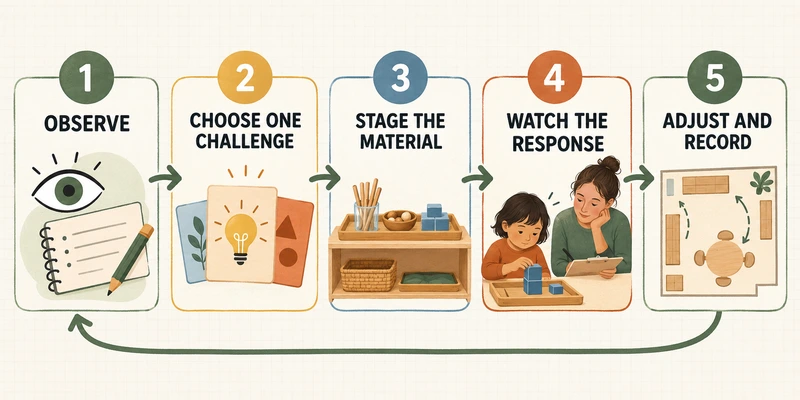
A simple weekly routine helps staff turn observations into action without writing a separate lesson plan for every child:
- Review one clear piece of evidence. Identify what the child can already do independently.
- Choose one next-step challenge. Change depth, complexity, pace, or the required explanation.
- Stage the material. Place it where the child can access it and where staff can supervise the work.
- Observe the response. Record engagement, strategy, productive struggle, help needed, and interaction with peers.
- Adjust the environment. Keep, simplify, extend, move, or rotate the activity based on what happened.
This cycle prevents random enrichment. It also gives directors useful information for material rotation, staff planning, family conversations, and future purchases.
What Directors Should Check Before Purchasing
A gifted-supportive classroom depends on the relationship between curriculum, furniture, storage, and staff workflow. When reviewing preschool furniture and storage options, use these checks:
- Access: Can children choose and return materials independently at their current physical development level?
- Supervision: Do shelves, dividers, and quiet areas preserve clear staff sightlines and access routes?
- Flexibility: Can the room support individual focus, peer work, and group discussion without a complete reset?
- Material fit: Do shelf openings, trays, tables, and floor areas fit the complete activity and its extension components?
- Operations: Can staff label, rotate, inventory, clean, and replace materials without creating an unmanageable system?
- Verification: Has the supplier provided current product dimensions, material information, anchoring instructions, cleaning guidance, and applicable test or compliance documents?
Plan the room around the age mix and actual learning sequence, then select products. This reduces overbuying, protects usable floor area, and leaves room for the curriculum to change as the cohort changes.
If you are planning a new preschool classroom or adapting an existing room, Xiha Montessori can review your floor plan, age group, teaching approach, storage needs, and preferred furniture system before product selection.
Contact Our Team for More Information Get CatalogCommon Mistakes to Avoid
- Giving extra quantities of familiar work. Increase thinking demand, not worksheet length.
- Using one advanced behavior as proof. Look for patterns across time, settings, and domains.
- Filling every shelf. Too many choices make progression, cleanup, and meaningful observation harder.
- Creating a permanent gifted corner. Flexible zones allow challenge to follow the child’s needs and interests.
- Removing play for early academics. Play, movement, social experience, and practical routines remain essential.
- Expecting independent work without instruction. Advanced children may still need help with planning, organization, collaboration, and persistence.
When to Consider Formal Assessment or Acceleration
Consider further review when a child consistently performs well beyond the available curriculum, ordinary differentiation no longer provides enough challenge, or an early school-entry decision is approaching. Decisions about acceleration should use professional assessment, evidence of advanced achievement, and discussion among the family and school team. The child’s readiness, well-being, and local admission policy all matter.
While that process is underway, the preschool can continue offering appropriate challenge through observation, flexible grouping, deeper questions, sustained projects, and a prepared environment. Support should not be delayed until a label is finalized.
Frequently Asked Questions
How Can Teachers Recognize a Gifted Preschooler?
Look for repeated evidence of advanced learning rate, depth, memory, reasoning, creativity, or performance in one or more domains. Record observations across different activities, compare family and classroom information, and follow local procedures when formal identification is appropriate.
Are Gifted Preschoolers Advanced in Every Area?
No. A child may show advanced language or mathematical reasoning while having age-typical motor, social, or emotional skills. Plan challenge by domain and continue supporting the child’s full development.
Can a Montessori Classroom Support Gifted Preschoolers?
Yes, when the prepared environment includes sequenced materials, independent access, observation-led presentations, uninterrupted work time, and extensions with genuine depth. Self-paced access alone is not enough; teachers still need to introduce new challenge and review the child’s progress.
Should a Gifted Preschooler Start School Early?
Early entry can suit some children, but it is an individual placement decision. Review academic readiness, social and emotional factors, assessment evidence, the receiving school’s program, and local policy with qualified professionals and the family.
Create Challenge Without Losing Childhood
A supportive early learning environment gives gifted preschoolers suitable challenge while preserving play, relationships, movement, and time to develop across every domain. Start with observation, add one purposeful extension, and arrange the room so children can work independently, with peers, and under clear supervision. That system serves advanced learners and makes the classroom easier to adapt for every child.
Share this article:
Hey, I’m Roger, the founder of Xiha Montessori, a family-run business. We specialize in preschool furniture and educational solutions.
Over the past 20 years, we have helped clients in 55 countries and 2000+ preschools, daycares, and early childcare centers create safe and inspiring learning environments.
This article shares knowledge on making education more effective and enjoyable for children.
Wooden Preschool Furniture Care Guide For Busy Classrooms
Read More »
How to Childproof a Daycare Classroom: A Practical Safety Checklist
Read More »
Daycare Cribs Buying Guide: How to Choose Safe, Practical Sleep Furniture
Read More »
Object Permanence: What Babies Learn and How Montessori Activities Support It
Read More »
Effective Preschool Classroom Rules: How to Create a Safe and Orderly Learning Environment
Read More »
How to Start a Daycare: A Practical Planning Guide
Read More » Roger Cai
Education Specialists
Hey, I’m the author of this post.
Over the past 20 years, we have helped 55 countries and 2000+ Clients, like Preschools, Daycare, and Early Childcare Centres, to create safe and inspiring learning environments.
If you need a purchase or consultation, please contact us for a free product catalog and classroom layout design.