
Montessori Counting Sticks: A Practical Guide to Number Rods
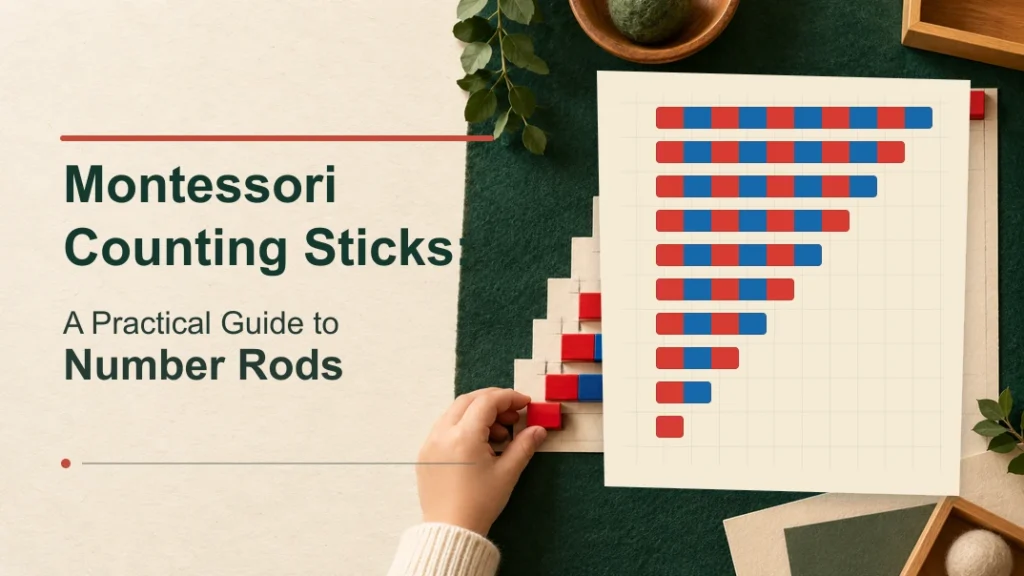
The phrase Montessori counting sticks usually refers to Number Rods: ten graduated rods divided into alternating red and blue units. Each rod presents a quantity from 1 to 10 as one continuous length. Loose counting sticks serve a different purpose because the child handles separate objects rather than one fixed quantity.
This distinction matters when a child can recite number words but cannot yet show what “five” means. Number Rods connect the spoken number, the counted segments, and the total length in one material. They prepare the child for numeral matching and later work with separate quantities.
What Montessori Counting Sticks Are
The standard Number Rod material contains ten wooden rods that range from 10 cm to 1 m. Each step adds one 10 cm unit, and the units alternate red and blue. The shortest rod represents one; the longest represents ten.
The design makes quantity visible without separating it into loose pieces. A child can hold “four” as one rod, count its four colored sections, and compare its total length with “three” or “five.”
Xiha procurement note: “Numerical Rods” can describe several products on a purchasing list. We have seen complete Number Rod sets, five-step sets, premium versions, and separate stands listed under similar names. A buyer should confirm the number of rods, size format, included numeral cards, and storage method instead of relying on the product name alone.
What Children Learn
- Quantity from 1 to 10: each spoken number is connected to a fixed, visible amount.
- Number order: the rods form a sequence in which each quantity is one unit greater than the last.
- Accurate counting: the child touches each colored segment once while saying one number word.
- Comparison: longer rods represent greater quantities and shorter rods represent smaller quantities.
- Quantity-symbol matching: numeral cards are added after the child knows the quantities and has experience with Sandpaper Numerals.
The rods also provide an early physical experience of the decimal system because ten equal units form the ten-rod. That is an indirect foundation, not a complete place-value lesson. Golden Beads later show units, tens, hundreds, and thousands more explicitly.
When a Child Is Ready
Age alone is a weak readiness test. Introduce Number Rods after the child can consistently work with the Red Rods. That earlier material teaches grading by length without adding number language.
Look for these signs:
- The child can arrange the Red Rods from shortest to longest.
- The child carries long materials with control and can work within a floor mat.
- The child can attend to a short, precise presentation.
- The child shows interest in number words or quantities.
A child who can say “one to ten” may still be working at the rote-counting stage. Within the broader Montessori math sequence, the Number Rod lesson should be timed to the child’s sensorial readiness, not presented simply because the child has reached a stated birthday.
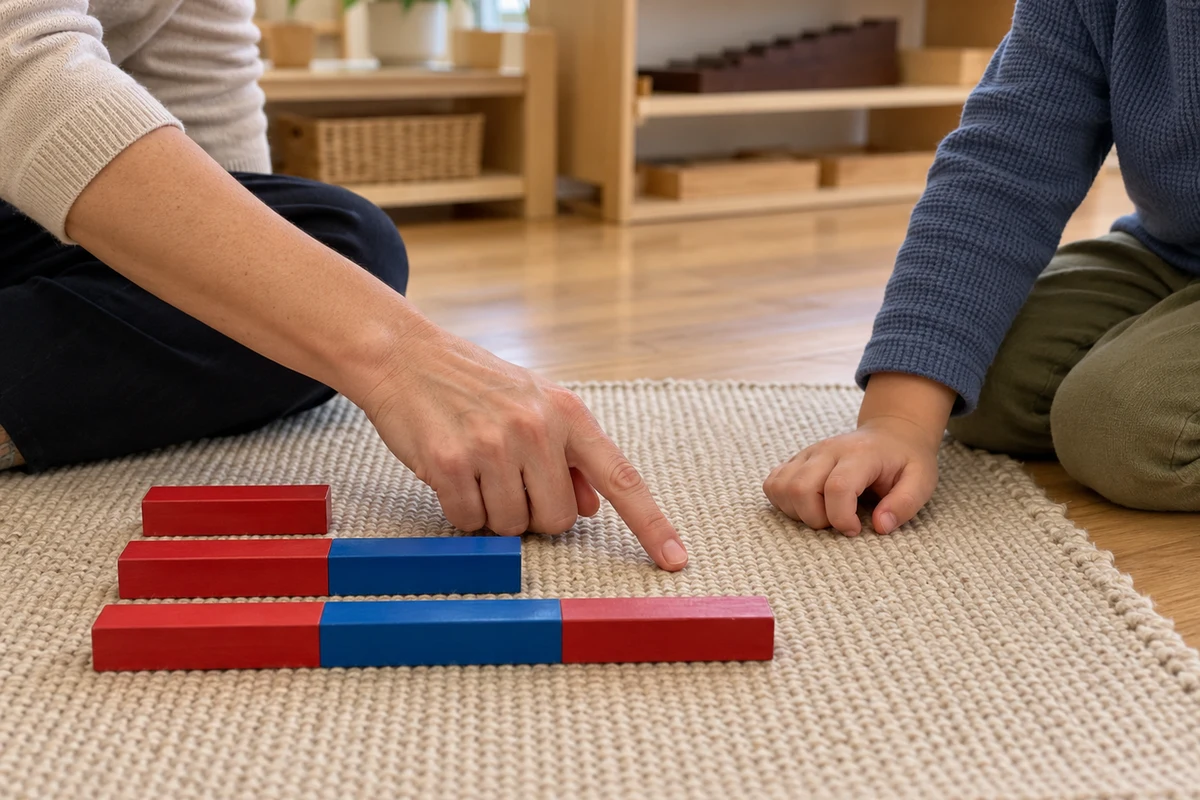
How to Present Number Rods
- Prepare a clear floor space. Unroll a work mat large enough for the longest rod. Carry full-size rods one at a time so the child can feel the change in length.
- Build the stair. Mix the rods, then grade them from one to ten with their red ends aligned. Pause so the child can see the regular steps.
- Begin with the first three rods. Isolate one, two, and three. Name each rod and count its sections from the aligned red end.
- Use the three-period lesson. Name the rods, ask the child to identify a named rod, then ask the child to name one. Keep the language short.
- Add rods gradually. Continue in small groups as the child remembers the previous quantities. Rebuild the full stair only when the sequence is manageable.
- Add numeral cards later. Once quantity names and Sandpaper Numerals are familiar, pair each card with the corresponding rod.
Compact rods can support tabletop practice, but they change the movement and large-scale length comparison of the standard material. Treat them as a distinct format and confirm how they fit your lesson sequence before substituting them for the full-size set.
How Children Check Their Work
The staircase gives immediate visual feedback. If two rods are out of order, the steps become uneven. Because adjacent rods differ by one unit, the one-rod can be moved along the staircase to compare each step. The child can also recount the colored sections to check a rod’s spoken name.
This control of error reduces constant adult correction, but it does not remove the guide’s role. A missing rod, inconsistent unit length, unclear paint boundary, or reversed starting end can make the visual check unreliable. The guide first gives an exact presentation, then observes how the child uses the material.
Where Number Rods Fit in the Math Sequence
The Montessori math sequence moves from concrete quantities toward abstract symbols, with each material isolating a different part of early number understanding.
| Material | Main question it answers | What changes |
|---|---|---|
| Red Rods | Which rod is longer or shorter? | Length, without number language |
| Number Rods | What quantity does “three” or “eight” mean? | Fixed quantities from 1 to 10 |
| Sandpaper Numerals | What does each written numeral look and feel like? | Symbol shape and name |
| Number Rods and Cards | Which symbol matches each quantity? | Quantity-symbol association |
| Spindle Boxes | How can one numeral represent a group of loose objects? | Loose quantities and zero |
| Cards and Counters | Can the child build and organize each loose quantity? | Sequence, quantity, and odd-even pattern |
This sequence explains why Number Rods should not be replaced with a box of craft sticks. Loose sticks are useful for one-to-one correspondence, while Number Rods preserve each number as a complete, fixed quantity.
Full-Size, Compact, and Five-Step Sets
| Format | Best fit | What to confirm |
|---|---|---|
| Full-size 1–10 set | The standard first presentation and floor work | Ten rods, 10 cm unit progression, space for the 1 m rod, and suitable storage |
| Compact 1–10 set | Tabletop follow-up, smaller rooms, or supplementary practice | Consistent proportions, exact set count, intended lesson use, and whether cards are included |
| Five-step set | A limited 1–5 exercise or a specific supplementary activity | That it is a partial set and does not provide the full 1–10 sequence |
A compact set can solve a storage problem, and a five-step set can suit a narrow lesson. Neither should be described as the standard full Number Rod material without clearly stating the change. For school purchasing, lesson intent comes before product format.
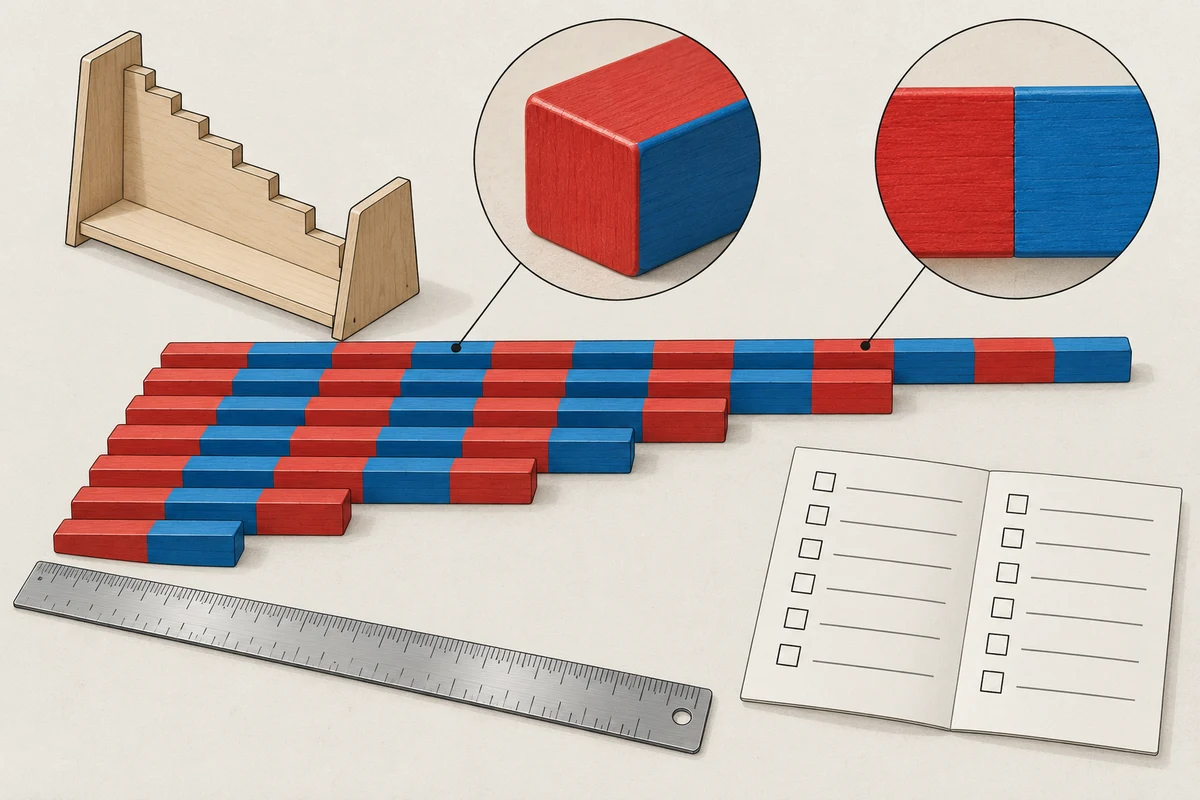
What Schools Should Check Before Buying
Confirm the complete set
Specify whether the order includes ten rods, numeral cards, a floor or tabletop format, and a stand or box. A missing four-rod breaks the sequence; an assumed stand can create an immediate storage problem. Put every component on the quotation and packing list.
Check proportion and paint boundaries
Each increment must be consistent, and every red or blue section should represent one equal unit. Uneven rod lengths or unclear color boundaries weaken the material’s visual control of error. Ask for current dimensions and clear product photos for the exact SKU, then inspect the delivered set before it reaches the shelf.
Match the format to the room
A standard ten-rod is 1 m long, so the classroom needs a floor mat, a clear carrying route, and storage that does not bend or crowd the rods. A compact version reduces the footprint but also reduces the large-movement experience. Review the room layout and teaching plan together.
Verify material, finish, and cleaning guidance
Request the current wood, coating, edge-finish, and cleaning specifications for the selected product. Material names alone do not prove resistance to frequent cleaning. If durability or chemical-safety claims affect the purchase decision, ask for the applicable test report for that exact product and destination market.
Plan inspection and replacement
Count every rod on arrival, check that the color sequence begins consistently, and compare adjacent increments. Keep the set together during classroom use. Before ordering, ask whether individual replacement rods are available; replacing one lost piece is easier than taking an incomplete sequence out of service.
Common Presentation Mistakes
- Starting with all ten rods: begin with a small group so the child can connect names and quantities accurately.
- Teaching numeral symbols at the same time: first establish quantity names; add cards after the child knows Sandpaper Numerals.
- Presenting before Red Rod readiness: the child then has to solve length grading and number language at once.
- Counting from inconsistent ends: align the red ends and use the same direction so the sections remain visually predictable.
- Using a partial set without saying so: a five-step product cannot demonstrate the complete 1–10 sequence.
- Explaining every correction: give the initial presentation precisely, then allow the staircase and segments to provide feedback.
Frequently Asked Questions
Are Montessori counting sticks the same as Number Rods?
Often, yes. Online stores use “counting sticks,” “numerical rods,” and “Number Rods” inconsistently. Check the product description. Montessori Number Rods are graduated, red-and-blue rods that represent fixed quantities from 1 to 10; loose sticks and Cuisenaire rods are different materials.
What is the difference between Red Rods and Number Rods?
Red Rods isolate length. Number Rods keep the same graduated structure but divide it into colored units and attach number names to fixed quantities. Red Rod work normally comes first.
Do Number Rods teach written numerals?
The first lesson teaches spoken number names and quantities. Sandpaper Numerals introduce written symbols. Number Rods and numeral cards later connect those two experiences.
Do Number Rods teach zero?
No. Number Rods begin with one because each rod represents a visible quantity. The Spindle Boxes give a clearer first experience of zero through an empty compartment.
Can a compact set replace full-size Number Rods?
It can support practice when space is limited, but it changes the carrying, floor work, and physical contrast of the standard material. Decide whether the set is for the first presentation or follow-up work, then confirm its proportions and components.
Choose the Set Around the Lesson
Number Rods work because their dimensions, color divisions, and lesson sequence support the same idea: each number from 1 to 10 is a complete quantity that can be named, counted, ordered, and compared. A purchasing decision should protect that relationship.
Xiha Montessori supplies Montessori materials for classroom projects. Share the children’s age range, lesson plan, room dimensions, and material list with our team. We can help you distinguish full-size, compact, and partial sets, confirm current specifications, and plan suitable storage before ordering.

Hey, I’m Roger, the founder of Xiha Montessori, a family-run business. We specialize in preschool furniture and educational solutions.
Over the past 20 years, we have helped clients in 55 countries and 2000+ preschools, daycares, and early childcare centers create safe and inspiring learning environments.
This article shares knowledge on making education more effective and enjoyable for children.

Wooden Preschool Furniture Care Guide For Busy Classrooms
Read More »
How to Childproof a Daycare Classroom: A Practical Safety Checklist
Read More »
Daycare Cribs Buying Guide: How to Choose Safe, Practical Sleep Furniture
Read More »
Object Permanence: What Babies Learn and How Montessori Activities Support It
Read More »
Effective Preschool Classroom Rules: How to Create a Safe and Orderly Learning Environment
Read More »
How to Start a Daycare: A Practical Planning Guide
Read More » Roger Cai
Education Specialists
Hey, I’m the author of this post.
Over the past 20 years, we have helped 55 countries and 2000+ Clients, like Preschools, Daycare, and Early Childcare Centres, to create safe and inspiring learning environments.
If you need a purchase or consultation, please contact us for a free product catalog and classroom layout design.