
Social Development in a Montessori School: A Practical Guide
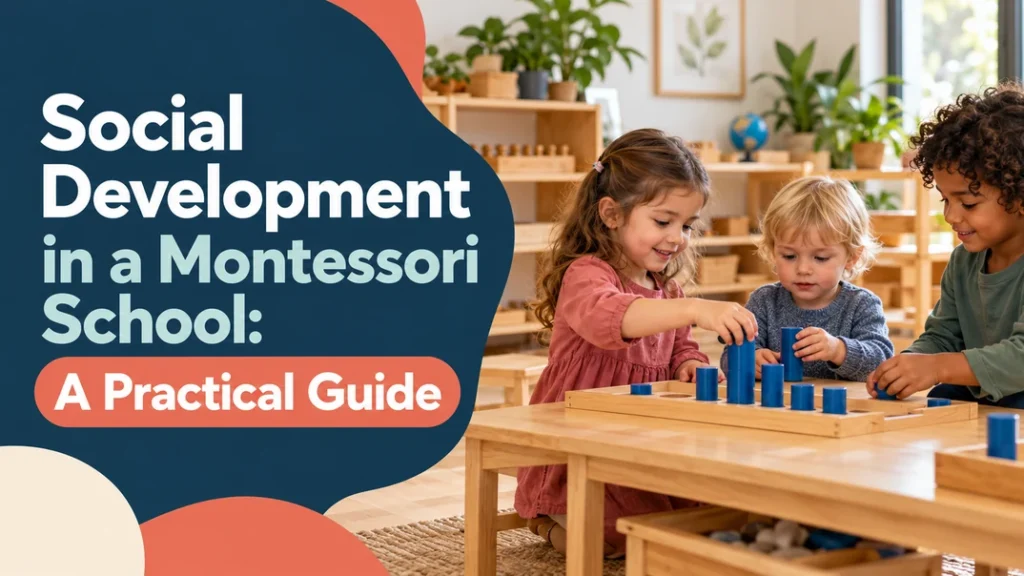
Social development in a Montessori school grows through daily choices, shared responsibility, and carefully guided interaction—not through constant group work. If you are planning or evaluating a program, look beyond whether children appear quiet or busy. You should examine how they enter play, wait for materials, solve small conflicts, help peers, and care for common spaces. This guide explains which classroom practices and design decisions make those behaviors more likely.
What Social Development in a Montessori School Looks Like
Social development in a Montessori school is the gradual ability to participate in a community while retaining independence. You should see children learning to communicate needs, respect another person’s work, take turns, offer appropriate help, repair disagreements, and contribute to routines that serve the group.
That balance matters because independent work is sometimes mistaken for social isolation. In a well-run classroom, concentration and community support each other. A child learns to choose work without disrupting others, while the group provides real situations in which patience, empathy, leadership, and self-control are needed. The Association Montessori Internationale identifies mixed ages, everyday life together, and grace and courtesy activities as central conditions for this process.
The evidence is promising but not uniform. A 2025 national lottery-based study of public Montessori preschool found stronger end-of-kindergarten results in social understanding, but it did not find an advantage on every social measure. A Montessori label does not guarantee better social skills. Classroom practices, adult guidance, and the prepared environment shape how much social opportunity children actually receive.
How the Montessori Environment Builds Social Skills
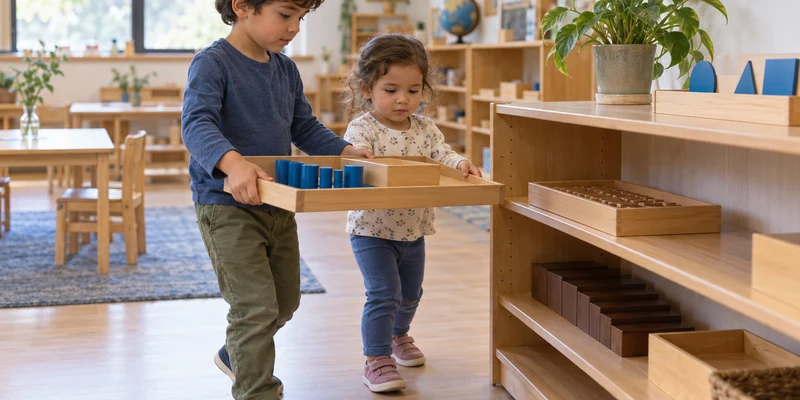
Mixed-age groups create changing social roles
In a mixed-age classroom, a child can observe a more experienced peer, work beside someone at a similar level, and later become the person who offers help. This variety creates more social roles than a room in which everyone is expected to do the same task at the same time. You can explore the planning implications in our guide to mixed-age classroom benefits.
The age range alone does not create cooperation. Older children should not become unpaid assistants, and younger children still need direct teaching and safe boundaries. Research on mixed-age settings is mixed when grouping is treated as the only variable; teacher preparation, classroom management, peer skills, and the quality of the environment affect the result. You should therefore evaluate how adults protect uninterrupted work, invite peer help without forcing it, and provide challenging choices across the full age range.
Grace and courtesy turns expectations into actions
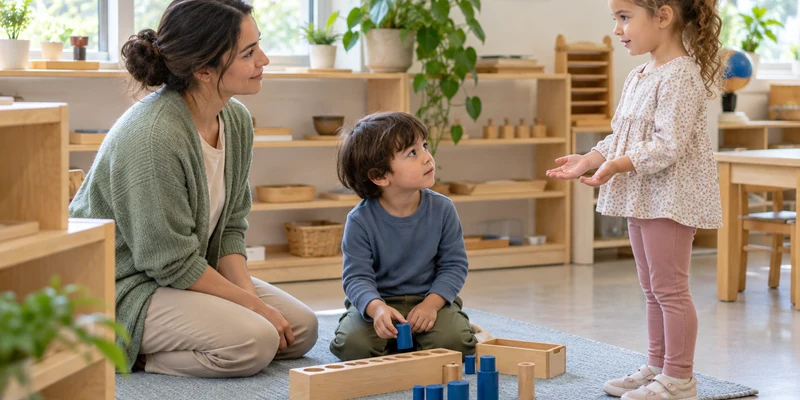
Grace and courtesy lessons make social expectations visible. Instead of repeatedly telling children to “be respectful,” an adult demonstrates a specific action: how to walk around a floor mat, ask to join an activity, decline politely, wait to speak, carry a chair past another worker, or return a shared item. Children can then rehearse the language and movement before a difficult moment occurs.
These lessons work best when they are brief, concrete, and consistent with adult behavior. If adults interrupt children, move materials without asking, or apply rules unpredictably, the lesson loses credibility. The aim is practical social competence, not polished manners for display.
Shared materials create coordination when access is planned
Keeping one complete set of a material on the shelf can give children a real reason to observe, wait, choose an alternative, and negotiate access. However, “one of everything” should not become a rigid purchasing rule. If several children need the same high-use item during arrival, snack preparation, or cleanup, too little equipment creates queues rather than useful social practice.
You should decide quantities by watching demand, activity duration, age, and schedule. Keep one set when waiting is manageable and educational; add duplicates or stagger access when scarcity repeatedly stops work or causes avoidable conflict. Clear shelf locations and complete material sets matter just as much as quantity because children cannot coordinate responsibly when pieces are missing or return points are unclear.
Small-group work provides a reason to communicate
Montessori classrooms include individual work, but they also need selected activities that genuinely benefit from two or more participants. Language games, collaborative research, music, food preparation, gardening, and some cultural work can require children to explain an idea, divide responsibility, listen, and adjust a plan.
Do not create group work by simply seating children together. The task should contain a shared purpose, and the furniture should give each child enough room to participate without crowding the materials. If one child can complete the entire task while others watch, the setup is not developing collaboration.
Practical life connects independence with responsibility
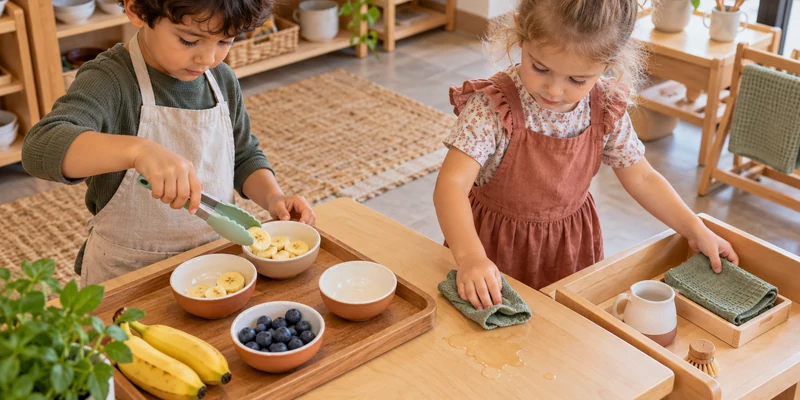
Practical life routines connect personal independence with responsibility to the group. Preparing a snack, watering plants, washing a table, sorting supplies, and restoring a work area affect the next person who uses the space. These routines make responsibility visible and give children concrete ways to contribute to the classroom community.
For this to work, tools and storage must be usable by the intended age group, the sequence must be clear, and cleanup must have a defined endpoint. Our guide to Montessori practical life explains how purposeful everyday activities support independence and participation.
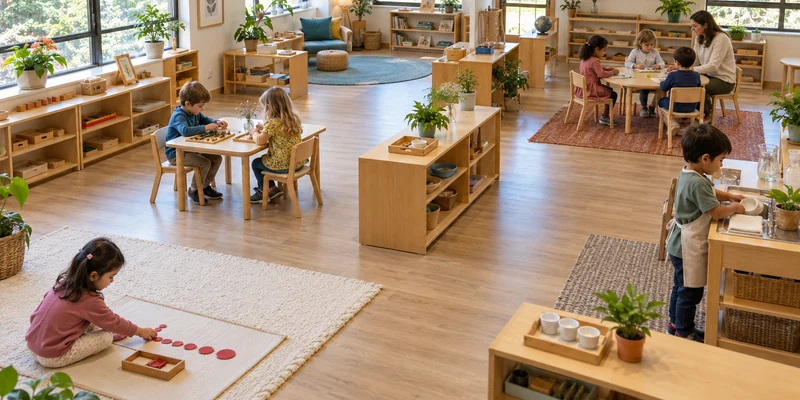
How Classroom Layout and Furniture Affect Social Interaction
The room cannot teach empathy by itself, but it can make respectful interaction easier or harder. In classroom planning, the important question is not whether furniture looks “Montessori.” You should ask what behavior each zone makes possible, where conflicts are likely to occur, and whether adults can observe without controlling every interaction.
| Design decision | Social purpose | What you should check |
|---|---|---|
| Low, open shelving | Defines work areas and lets children select and return materials independently | Confirm reach for the intended age group, stable construction, clear labels or visual order, and adult sightlines from normal supervision points |
| A mix of individual and small-group tables | Lets children choose concentration, parallel work, or collaboration | Avoid making every seat communal or every seat isolated; compare table capacity with the activities actually planned |
| Floor-work rugs and clear paths | Give work a visible boundary and reduce accidental interruption | Test whether children and adults can move around occupied rugs without stepping through another child’s work |
| Accessible practical life and snack stations | Creates authentic opportunities for service, turn-taking, and shared routines | Check tool size, storage sequence, spill management, cleaning method, and proximity to water or waste points where relevant |
| A calm conversation area | Provides a place for supported reflection or conflict repair | Keep it visible and available to everyone; do not design it as an isolated punishment corner |
Before ordering furniture, place these zones on a scaled plan and test likely movement during arrival, work time, snack, and cleanup. Shelf height, table size, and aisle clearance should be selected from children’s reach, activity needs, room dimensions, supervision, and applicable local requirements—not from a single universal number. Our Montessori classroom layout guide provides a broader planning framework.
What You Should Observe Instead of Assuming
You cannot judge social development from a quiet classroom visit or one polished group activity. Observe the same children across different routines and over time. Useful signs include whether a child can:
- ask to watch or join without taking over another child’s work;
- wait briefly or select another activity when a material is unavailable;
- offer help and accept “no, thank you”;
- state a problem, listen to another view, and participate in repair with appropriate adult support;
- return materials and restore shared spaces for the next user;
- move between individual concentration, parallel work, and genuine collaboration.
A child does not need to be highly talkative to be socially capable. Temperament, language, disability, culture, and familiarity with the environment affect how participation looks. Record the context, the level of adult support, and change over time rather than using one behavior as a label.
Common Mistakes That Limit Social Development
The first mistake is assuming that freedom removes the need for explicit teaching. Children need real choices within clear limits, plus calm demonstrations of how to use that freedom around other people.
Another mistake is treating group furniture as proof of collaboration. A large table can support conversation, but it can also create crowding, noise, material disputes, and passive participation. Match the table and seating arrangement to a defined activity, then observe whether every child can reach, contribute, and leave without disrupting others.
Schools also lose valuable information when adults solve every disagreement immediately. Step in for safety, intimidation, persistent exclusion, or a child who lacks the language to participate. For manageable problems, give enough support for children to name the issue, hear each other, and try a solution. Conflict is not evidence that social development has failed; repeated conflict without learning or repair is the stronger warning sign.
A Practical Planning Check for School Leaders
If you are opening or redesigning a Montessori classroom, review curriculum, staffing, daily routines, and furniture as one system. Start with the age range, enrollment, room dimensions, fixed doors and sinks, required supervision, and the activities that need individual, paired, small-group, or whole-community space.
Ask your supplier for dimensioned layouts rather than attractive renderings alone. You should be able to check children’s access, adult sightlines, the number and capacity of work surfaces, storage locations, cleaning routes, and how the room changes during busy transitions. Request current material and finish information for the actual products you are considering, along with applicable test or compliance documents. A material name or board thickness by itself does not prove cleanability, stability, or service life.
Xiha Montessori can review your floor plan, age range, activity needs, and preliminary product list through its classroom planning solution. The goal is to balance focused work, peer interaction, practical life, movement, and supervision before furniture quantities are finalized.
Contact Our Team for More Information Get CatalogFrequently Asked Questions
Does independent work reduce socialization in Montessori?
No. Independent work can support self-regulation and respect for another person’s concentration. Social development also occurs through observation, mixed-age peer contact, small-group lessons, practical life routines, shared materials, outdoor activity, and conflict repair. The problem is not independence; it is a program that provides no meaningful opportunities or guidance for interaction.
How much group time does a Montessori classroom need?
There is no useful universal number. Schedule group time for experiences that benefit from a shared audience or coordinated participation, such as music, stories, community discussions, or collaborative projects. Protect enough uninterrupted work time for children to choose individual, parallel, and partner activity. You should adjust the balance from observation rather than filling the day with meetings.
How can you support a child who prefers less verbal interaction?
Do not treat quiet behavior as a problem by itself. Offer parallel work, predictable partner roles, visual cues, and brief language a child can use to join, decline, or request help. Start with one familiar peer or a small group rather than forcing whole-group participation. If communication consistently limits access or causes distress, coordinate observations with the family and appropriate specialists.
How should teachers document social development?
Record specific actions instead of labels such as “shy,” “bossy,” or “not social.” For each observation, note the routine, the peers present, what happened before the interaction, and the support an adult provided. Track whether the child could join, wait, communicate, or repair the problem. Comparing the same behaviors across several weeks gives you better evidence than a single successful or difficult day.
Conclusion
Social development in a Montessori school is strongest when independence, explicit guidance, meaningful responsibility, and a well-planned environment reinforce one another. If you evaluate observable behavior and design the room around real routines, you can create more opportunities for children to cooperate, recover from conflict, and participate confidently in their classroom community.
Share this article:
Hey, I’m Roger, the founder of Xiha Montessori, a family-run business. We specialize in preschool furniture and educational solutions.
Over the past 20 years, we have helped clients in 55 countries and 2000+ preschools, daycares, and early childcare centers create safe and inspiring learning environments.
This article shares knowledge on making education more effective and enjoyable for children.

Wooden Preschool Furniture Care Guide For Busy Classrooms
Read More »
How to Childproof a Daycare Classroom: A Practical Safety Checklist
Read More »
Daycare Cribs Buying Guide: How to Choose Safe, Practical Sleep Furniture
Read More »
Object Permanence: What Babies Learn and How Montessori Activities Support It
Read More »
Effective Preschool Classroom Rules: How to Create a Safe and Orderly Learning Environment
Read More »
How to Start a Daycare: A Practical Planning Guide
Read More » Roger Cai
Education Specialists
Hey, I’m the author of this post.
Over the past 20 years, we have helped 55 countries and 2000+ Clients, like Preschools, Daycare, and Early Childcare Centres, to create safe and inspiring learning environments.
If you need a purchase or consultation, please contact us for a free product catalog and classroom layout design.